Power Outage Preparedness: A Homeowner Guide
The lights flicker, the furnace goes quiet, and suddenly the refrigerator, the Wi-Fi, the sump pump, and the garage door all stop at once. A power outage rarely arrives alone; within an hour it touches your food, your water, your heat, and your family's routine. The households that ride out a blackout calmly are not luckier than everyone else - they prepared before the first flicker.
This guide covers practical power outage preparedness for ordinary homes in the United States and Canada: a 72-hour plan and kit, how long your fridge and freezer really stay cold, how to heat and light your home without a carbon monoxide hazard, and what to do the moment power returns.
The short version
- Aim for a 72-hour baseline of supplies - the readiness target used by Ready.gov in the U.S. and most provincial emergency programs in Canada.
- Keep the fridge closed: a full refrigerator holds a safe temperature about 4 hours, and a full freezer about 48 hours (24 if half full).
- Never run a generator, camp stove, grill, or propane heater indoors, in a garage, or near a window - carbon monoxide is odourless.
- Store at least 4 litres / 1 gallon of water per person per day; if you rely on a well, the pump stops when the power does.
- Use LED flashlights and lanterns instead of candles, and keep a battery or hand-crank radio for alerts.
- Unplug sensitive electronics and leave one light on so you know the instant power returns.
What a Power Outage Actually Knocks Out
A blackout is never just about light. The moment the grid drops, a chain of systems goes quiet, and each has its own clock. Understanding that chain is the first step in power outage preparedness.
- Heat and cooling. Most furnaces need electricity for the blower and thermostat, so a gas furnace often stops even when the gas still flows. Central air and heat pumps stop outright.
- Water. A private well pump is electric, so no power means no running water at all. Municipal water usually keeps flowing, but pressure can drop.
- Basement flooding. A sump pump is a small motor doing a big job - often the only thing keeping water out during the same storm that cut the power.
- Food. The fridge and freezer warm immediately; how long food stays safe depends on how full they are and how often you open them.
- Communication. Cordless phones and Wi-Fi die with the power, and cell towers may stay up but get congested.
- Access. Electric garage doors, elevators, and some medical devices stop where they are.
Outages come from storms, high winds, extreme heat, wildfires, vehicle accidents, or plain equipment failure. You cannot schedule them, so prepare for a general loss of power.
Power Outage Preparedness Starts With a 72-Hour Plan
Emergency-management agencies on both sides of the border converge on the same baseline: be ready to manage on your own for at least 72 hours. Ready.gov, FEMA's public readiness site, and provincial programs across Canada all build around that window, because it is roughly how long crews and supplies can take to reach everyone after a wide-area event.
Write the plan down - in a dark house, nobody remembers phone numbers or where the flashlight went.
Put it on paper
- A contact list for family, neighbours, your pharmacy, your utility, and your insurance.
- An out-of-area contact everyone checks in with, so the family can reconnect when local lines are busy.
- Who depends on powered medical equipment, who takes refrigerated medication, and each person's backup.
- Pets: food, water, medications, carriers, and whether your planned shelter accepts them.
Practice it once
Turn off the main breaker for two hours on a weekend and watch what happens. Can you find a flashlight without a phone? Does the garage-door release work? One dry run exposes the gaps a checklist cannot.
This guide is part of the free The Ultimate Preppers Guide 2027 - 56 pages of checklists, tables and reference sheets you can print and keep.
Build a Power Outage Kit in One Place
The biggest reason preparedness fails is scattered supplies - batteries in a drawer, a flashlight in the car, a radio in the basement. Keep one labelled bin, and tell every adult where it lives.
| Item | Why it matters |
|---|---|
| LED flashlights (one per person) plus a lantern | Safer than candles; a lantern lights a whole room |
| Spare batteries in common sizes | Matches your flashlights and radio |
| Battery or hand-crank radio | Local alerts when the internet is down |
| Power banks, charged | Keeps phones alive for texts and alerts |
| Appliance thermometer | Confirms fridge and freezer temperatures |
| Manual can opener | Opens shelf-stable food without power |
| First-aid kit and personal medication | Handles small problems without a trip out |
| Water (4 L / 1 gallon per person per day) | Covers drinking and basic hygiene |
Charge power banks and phones before a forecast storm. A phone in low-power mode used mainly for texts can last well over a day; a large power bank stretches that to several.
Keep Food Safe: The 4-Hour and 48-Hour Rules
Food safety during an outage comes down to temperature and time. The danger zone is between 40°F and 140°F (4°C and 60°C), where bacteria multiply fastest. U.S. Department of Agriculture guidance and Canadian food-safety advice agree on the core rules.
| Appliance | How long food stays safe |
|---|---|
| Refrigerator (kept closed) | About 4 hours |
| Full freezer | About 48 hours |
| Half-full freezer | About 24 hours |
Every time you open the door you let cold air out, so resist the urge to check. If the outage looks long, group food together in the freezer to add thermal mass, and move the most perishable items - dairy, meat, leftovers - into a cooler packed with ice or frozen water bottles.
When in doubt, throw it out
- Discard perishable food that has been above 40°F / 4°C for more than 2 hours.
- Never taste food to decide if it is safe - the bacteria that make you sick usually do not change the taste or smell.
- A closed, full freezer can refreeze food that still has ice crystals; if it has thawed and warmed past 40°F / 4°C, discard it.
- Keep an appliance thermometer in the fridge so you have a number, not a guess, when power returns.
Heat, Light, and Carbon Monoxide: The Line You Do Not Cross
Every year, people are harmed in outages not by the cold but by the appliances they bring inside to fight it. Carbon monoxide (CO) is an odourless, colourless gas produced by anything that burns fuel - gasoline, propane, natural gas, charcoal, or wood. It builds quietly in a closed space.
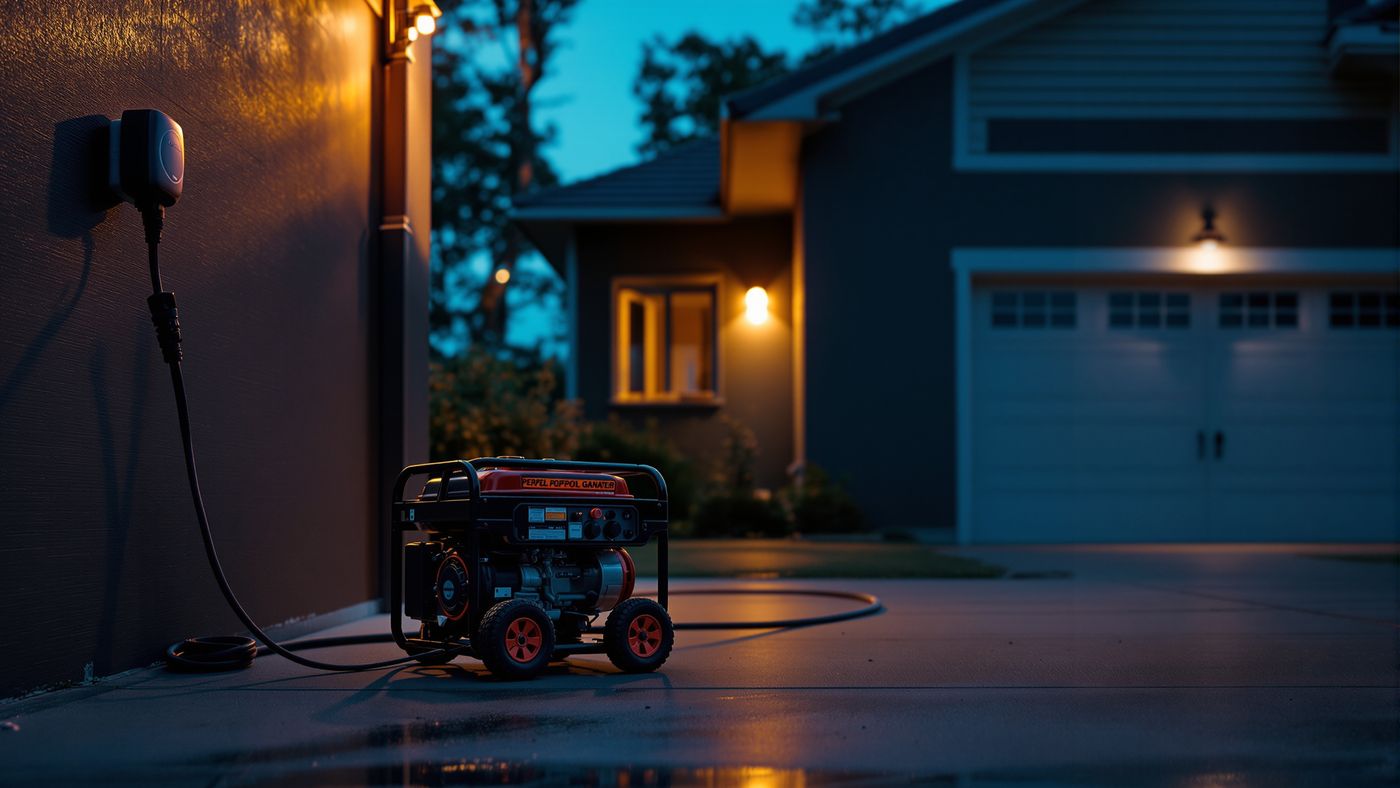
The rule is absolute: never run a generator, camp stove, charcoal grill, or propane heater indoors, in a garage, in a basement, or near a window or door. There is no safe indoor use, and no amount of ventilation makes it acceptable.
Heating safely
- If you use a portable space heater on a working circuit, keep at least 3 feet / 1 metre of clearance from curtains, bedding, and furniture, and never leave it unattended while sleeping.
- Do not use an oven or gas range to heat the home - it is a fire and CO hazard.
- Have wood stoves and fireplaces inspected and cleaned annually; a blocked flue is a CO trap.
- Keep CO alarms on every level and outside sleeping areas, and test them monthly.
Lighting safely
Choose LED flashlights and lanterns over candles, which are an open flame in a dark house and a common cause of home fires.
Water, Wells, Sump Pumps, and Medications
Some of the least visible parts of power outage preparedness matter most. A well pump that stops is not a minor inconvenience - it means no water for drinking, cooking, flushing, or washing, with no warning.
Wells and water
If you are on a well, store drinking water in advance - 4 litres / 1 gallon per person per day is the standard starting point. You can also fill bathtubs before a forecast storm for flushing and cleaning, but not for drinking.
Sump pumps
If your basement relies on a sump pump, a battery-backup pump or a water-powered backup can keep it running when the grid cannot. At minimum, know where it discharges and keep the pit clear.
Medications
- Refrigerated medication such as insulin can usually be kept in a cooler with gel packs; ask your pharmacist in advance how long it can safely be out of the fridge.
- Keep a written list of medications, doses, and prescribing doctors in your kit.
- For powered medical equipment (oxygen concentrators, CPAP, dialysis), talk to your provider and utility about priority restoration and a backup plan before you need it.
Communication and Information During a Blackout
When the power goes out, phone networks get busy. A short text often gets through when a call will not, because a text needs far less network capacity. Agree in advance that your family will text rather than call, and that everyone checks in with the out-of-area contact.
- Use a battery or hand-crank radio to follow local alerts and restoration estimates.
- Follow your utility's outage map and text-alert service rather than relying on rumour.
- A car can charge a phone in an emergency - but never run a car in an attached garage.
When the Power Comes Back: Resetting Safely
The lights coming back is good news, but there is a short list of things to do carefully. When power returns to a whole neighbourhood at once, it can also bring a surge that damages sensitive electronics.
- Wait a moment before switching on major appliances, and bring them online one at a time.
- Check the fridge and freezer with your thermometer and discard anything that stayed too warm too long.
- Reset clocks, and re-check that smoke and CO alarms are working.
- Restock whatever you used, and note what you wished you had - that is how the kit improves each time.
If you ran a portable generator, shut it down, let it cool, and store it and its fuel safely until next time.
Power Outage Preparedness for Renters and Apartments
If you rent, you cannot rewire the building, but you can still be ready. Focus on what you control: light, warmth, food, water, and information inside your unit.
- Skip fuel-burning heat and generators entirely in a multi-unit building - CO travels between units, and generators violate most leases and fire codes.
- Plan for stairs if the elevators are out.
- Keep a blanket, warm layers, and a battery lantern near your bed, and know where the exits and shutoffs are.
- Ask your landlord how common areas, alarms, and water pumps are backed up.
Frequently asked questions
What should a power outage preparedness kit include?
One LED flashlight per person, a lantern, spare batteries, a battery or hand-crank radio, charged power banks, an appliance thermometer, a manual can opener, a first-aid kit, personal medications, and stored water. Keep it all in one labelled bin so anyone can find it in the dark.
How long will food stay safe in a power outage?
A closed refrigerator holds a safe temperature about 4 hours, and a full freezer about 48 hours (24 if half full). Discard perishable food above 40°F / 4°C for more than 2 hours, and never taste it to check.
Can I use my gas furnace during a power outage?
Usually not. Most furnaces need electricity for the blower and thermostat, so the heat stops even though the gas still flows. Check your manual, and never heat the home with an oven, gas range, or fuel-burning heater indoors.
Is it safe to use candles for light during an outage?
LED flashlights and lanterns are safer and give better light. A candle is an open flame in a dark house and a common cause of home fires. If you use them, never leave them unattended or near anything flammable.
How much water should I store for a power outage?
Plan on at least 4 litres / 1 gallon of drinking water per person per day, plus water for pets. If you are on a well, store extra because the pump will not run. Keep a 72-hour supply at minimum.
How do I start power outage preparedness on a budget?
Start with the cheapest, highest-impact items: an LED flashlight and spare batteries, a battery radio, a power bank, and a written contact list. Add a thermometer, stored water, and the rest as budget allows - you can build the whole kit over a few grocery trips.
What to do first
Do four things this week: charge every power bank and replace flashlight batteries, print your contact and medication list, put a thermometer in the fridge and freezer, and test your smoke and CO alarms. Then build the 72-hour bin one item at a time. Preparedness is not a purchase you make once - it is a habit you build before the lights go out.