Best Emergency Water Filters and Purifiers
Clean drinking water is the first thing to disappear in a serious emergency. A boil-water advisory, a broken main, a power outage that stops the treatment plant, or a flood that contaminates a well can all turn a reliable tap into a source you should not trust. Bottled water covers the first day or two, but a filter or purifier gives you something far more durable: safe drinking water from rivers, lakes, creeks, rain, and even questionable tap water.
This guide is for households building an emergency kit or a go-bag, and for anyone who wants a reliable way to treat water at home when the usual supply fails. We explain how to choose among emergency water filters and purifiers, the difference between a filter and a purifier, why pore size in microns is the single most important specification, how hollow-fibre, ceramic, carbon, chemical, and UV methods compare, and which well-known product families are worth shortlisting. The recommendations are based on published specifications and the reputations of established brands - not laboratory testing of our own.
We do not operate a testing laboratory, and we do not claim to. This guide is assembled the way an experienced buyer would assemble it: by reading published specifications, understanding what each treatment method actually removes, and favouring brands with long track records in backcountry and emergency use. Where a figure would be precise but model-specific - exact flow rates, cartridge lifespans, or current prices - we describe the class and tell you to check the current model specs before you buy.
We judge each product on the specifications that matter in an emergency: the pore size and what it removes, whether it handles bacteria only or also viruses, whether it needs power or chemicals, how much water it treats before it needs cleaning or replacement, how fast it flows, how heavy and packable it is, and how easy it is to maintain with no tools. We favour simple, field-proven designs over complicated ones, because during an emergency the device that works is the one that is easy to use and hard to break. We do not rank by brand name or price alone.
Our picks
LifeStraw Personal Series
Typical price band: $15-60
LifeStraw made the category famous, and the personal straw remains one of the simplest, most robust emergency water tools you can own. You drink directly through it, so there is nothing to pump, squeeze, or assemble in the dark. Its hollow-fibre membrane filters out bacteria and protozoa down to a very fine pore size, which covers the two categories responsible for most waterborne illness in the backcountry and after a disaster.
- Nothing to prime, pump, or power - ideal for a go-bag or a glovebox.
- Light and compact, so it is easy to carry several.
- Field-proven design that handles silty, questionable water.
Its limits are that it is designed for one person drinking on the go rather than filling a container for a family, and that a straw of this type typically filters but does not deactivate viruses. For household quantities or viral-risk water, pair it with a gravity system or chemical treatment. Check the current model specs for the exact pore rating and capacity.
- TypePersonal hollow-fibre straw filter
- Pore sizeApprox. 0.2-micron class (varies by model)
- RemovesBacteria and protozoa; not viruses
- Power neededNone
- Best forGo-bags, hikes, one-person use
- MaintenanceBackwash/replace per manufacturer
Pros
- Extremely simple to use
- Light, compact, and packable
- No power or chemicals required
Cons
- Not designed to fill large containers
- Does not treat viruses
- One-person-at-a-time use
Affiliate link - we may earn a commission at no cost to you.
Sawyer Squeeze System
Typical price band: $20-50
The Sawyer squeeze filter earns the value badge because it delivers a huge amount of treated water per dollar and works in more ways than a straw. You can drink straight from it, squeeze it into a bottle, or rig it into a gravity setup with two containers. The hollow-fibre element filters down to a fine pore size and is rated to handle a large volume of water before it needs replacing, making it a favourite for households that want one affordable tool that covers several jobs.
- Multi-mode: drink, squeeze, or use as a gravity filter.
- Very high rated capacity relative to cost.
- Compact and light for kits and go-bags.
Like most hollow-fibre filters it does not neutralise viruses, and it can clog with very silty water unless you pre-filter or backwash. It is also easiest to maintain with the supplied syringe. Confirm the current model's pore rating and capacity before buying.
- TypeHollow-fibre squeeze filter
- Pore sizeApprox. 0.1-micron class (varies by model)
- RemovesBacteria and protozoa; not viruses
- ModesDrink, squeeze, or gravity
- Power neededNone
- Best forValue-focused kits and families
Pros
- Versatile multi-mode design
- Very high rated capacity for the price
- Light and compact
Cons
- Can clog with silty water
- Backwashing needs the supplied tool
- Does not treat viruses
Affiliate link - we may earn a commission at no cost to you.
Katadyn Gravity and Pump Filters
Typical price band: $60-400
Katadyn is the premium, long-serving name in water treatment, and its gravity and pump families are the tools to reach for when you need to produce drinking water for a whole household rather than one hiker. A gravity system fills a reservoir and lets water trickle through an element into a clean container with no pumping at all, which is ideal for a family sheltering at home. Catadyn's ceramic and hollow-fibre elements are known for durability and field maintainability.
- Produces larger volumes for families and groups.
- Gravity models need no pumping or power.
- Serviceable elements that can be cleaned and reused.
These systems cost more, are bulkier and heavier, and some premium models with carbon stages add filtration benefits beyond bacteria and protozoa. Ceramic elements are heavier and can crack if frozen. Check the current model specs for the pore rating, capacity, and whether a carbon stage is included.
- TypeGravity-fed and pump filters
- Pore sizeCeramic or hollow-fibre, sub-micron class
- RemovesBacteria and protozoa; carbon adds taste/chemical reduction
- Power neededNone
- Best forFamilies and whole-household water
- MaintenanceCleanable ceramic or backflushable element
Pros
- Handles large volumes for families
- Gravity models require no effort
- Durable, serviceable elements
Cons
- Higher cost and bulk
- Ceramic can crack if frozen
- Slower flow on gravity models
Affiliate link - we may earn a commission at no cost to you.
MSR Trail Series Filters
Typical price band: $40-120
MSR is a backcountry stalwart whose pump and trail filters are the runner-up for good reason: they are fast, rugged, and built for people who treat water in demanding conditions. An MSR pump fills a bottle or a hydration bladder quickly, and the hollow-fibre elements are designed to be field-maintained. If your emergency plan leans toward hiking out or drawing water from streams, an MSR filter is a dependable companion.
- Fast flow for filling containers on the move.
- Rugged, backpacking-grade construction.
- Field-maintainable cartridges.
Pump filters require more effort than gravity systems and add a little more bulk and weight, and hollow-fibre elements do not treat viruses. Confirm the current model specs for pore size, flow, and capacity.
- TypePump and trail filters
- Pore sizeApprox. 0.2-micron class hollow-fibre
- RemovesBacteria and protozoa; not viruses
- Power neededNone
- Best forBackcountry and travel
- MaintenanceField-serviceable cartridge
Pros
- Fast filling for bottles and bladders
- Rugged build for hard use
- Field-maintainable elements
Cons
- Pumping takes effort
- A little heavier and bulkier
- Does not treat viruses
Affiliate link - we may earn a commission at no cost to you.
LifeStraw Home Pitchers and Dispensers
Typical price band: $30-100
For apartment dwellers and families who want treated water in the kitchen without any outdoor gear, the LifeStraw Home pitchers and dispensers are a natural fit. They look and work like an ordinary water pitcher, but combine a hollow-fibre membrane with a carbon stage to improve taste and reduce some chemicals, so they double as everyday filters and emergency backups. That versatility is the point: a device you use daily is one that is always primed and ready when something goes wrong.
- Countertop-friendly and easy for anyone in the household to use.
- Membrane plus carbon improves taste and reduces some contaminants.
- No power or pumping; works during an outage.
Its limits are volume and source: a pitcher is designed for tap water, not for muddy river water, and it produces drinking water a litre or two at a time. For grossly contaminated sources, pre-filter and use a field filter or chemical treatment first. Check the current model specs for pore rating and filter life.
- TypeCountertop pitcher / dispenser filter
- Pore sizeHollow-fibre membrane plus carbon stage
- RemovesBacteria/protozoa plus some chemical and taste reduction
- Power neededNone
- Best forApartments and everyday-plus-emergency use
- MaintenanceReplaceable filter cartridge
Pros
- Fits everyday kitchen use
- Membrane plus carbon stage
- No power required
Cons
- Not built for muddy raw water
- Small batch volumes
- Cartridges need replacing on schedule
Affiliate link - we may earn a commission at no cost to you.
Potable Aqua and Aquatabs Tablets
Typical price band: $10-25
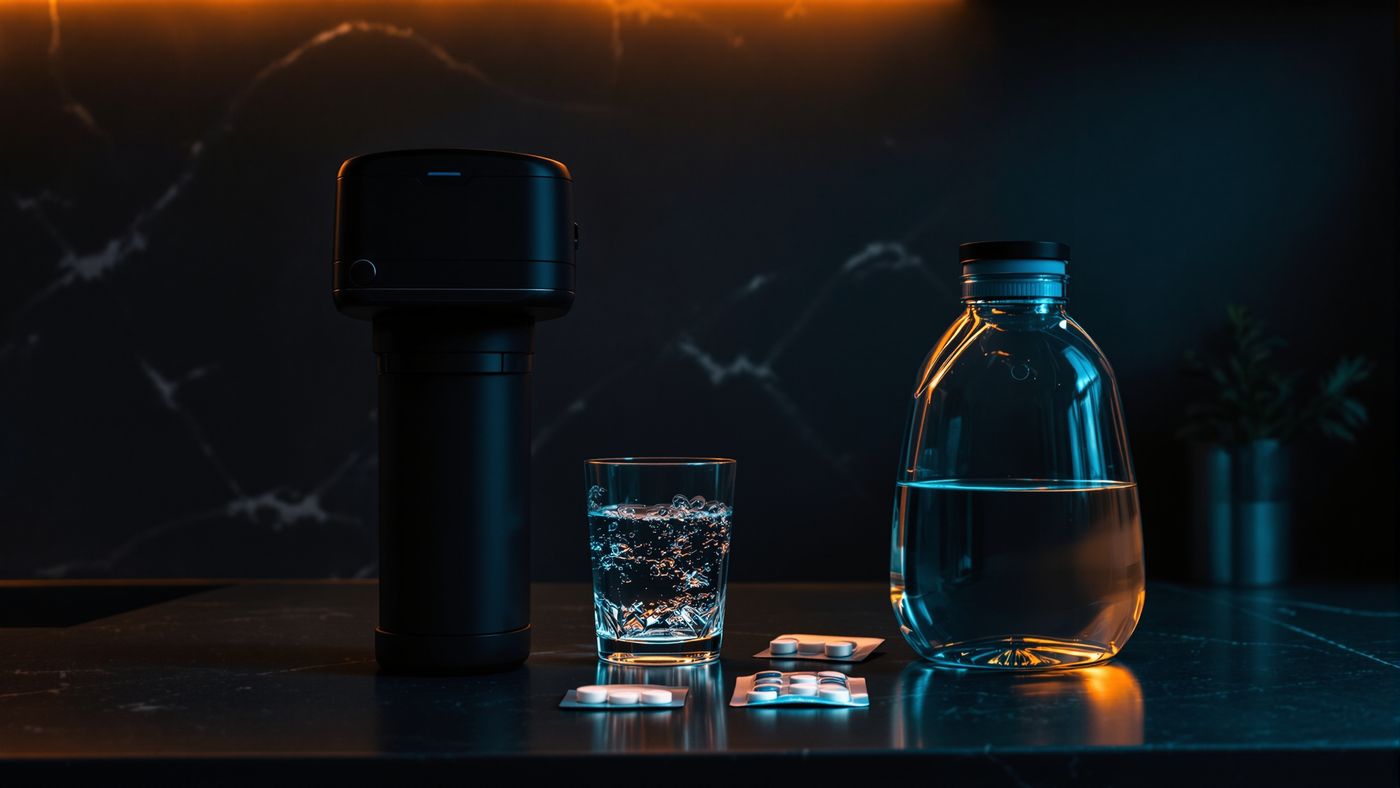
Chemical treatment is the humble, indispensable backup. Potable Aqua and Aquatabs tablets are tiny, cheap, and effectively weightless, and they kill bacteria and viruses in clear water when a filter cannot. Because most field filters do not neutralise viruses, a small packet of tablets is a smart complement to any filter and a complete stand-alone solution for a minimalist kit.
- Treats bacteria and viruses, which filters alone may not.
- Almost weightless and extremely inexpensive.
- No moving parts to break or clog.
The trade-offs are wait time, taste, and the fact that some chemicals are less effective in very cold or very cloudy water. Follow the label's dosing and contact-time instructions exactly, and note the shelf life. Check the current product specifications for dosage and expiration.
- TypeChemical purification tablets
- RemovesBacteria and viruses (per label)
- Power neededNone
- Best forBackup and minimalist kits
- Wait timeVaries by product and water temperature
- MaintenanceNone; check expiration date
Pros
- Treats viruses as well as bacteria
- Tiny and very inexpensive
- No parts to break or clog
Cons
- Wait time before drinking
- May leave a taste
- Less effective in cold or cloudy water
Affiliate link - we may earn a commission at no cost to you.
What actually matters
Pore Size in Microns: What Emergency Water Filters Remove
The single most important specification on a water filter is its pore size, measured in microns. The smaller the pore, the more it removes.
- Protozoa such as Giardia and Cryptosporidium are the largest threats, typically in the several-micron range, so most filters catch them.
- Bacteria such as E. coli and Salmonella are smaller, generally under a micron, so a filter needs a pore size in the sub-micron range to be reliable.
- Viruses are far smaller still - typically measured in nanometres - and pass through most hollow-fibre and ceramic filters, which is why they need chemical or UV treatment.
An absolute rating - the largest particle that can get through - is more meaningful than a nominal one, so favour filters that publish it. Check the current model specs for the exact rating.
Filter vs Purifier: What Emergency Water Filters and Purifiers Do
The words are used loosely in marketing, but they mean different things.
- A filter physically strains out particles, protozoa, and bacteria.
- A purifier goes further and also deactivates viruses, usually by combining a filter with chemicals, UV light, or a virus-rated membrane.
In North America and much of Europe, the viral risk in backcountry streams is generally lower than in developing regions, so a filter may be adequate for many situations. But after a flood, a sewage overflow, or in water that may be contaminated by human waste, a purifier or a filter-plus-chemical combination is the safer choice. When in doubt, treat for viruses.
Emergency Water Filter and Purifier Methods Compared
Each method has strengths and blind spots, which is why the best kits often combine two.
- Hollow-fibre filters: fast, light, and durable; catch bacteria and protozoa; do not treat viruses. Sensitive to freezing.
- Ceramic filters: durable and cleanable, sometimes with a silver element to inhibit growth; heavier and can crack if frozen.
- Carbon stages: improve taste and reduce some chemicals and odours; not a primary barrier against pathogens.
- Chemical tablets: kill bacteria and viruses; slower and can affect taste; less effective in cold or cloudy water.
- UV purifiers: deactivate bacteria, protozoa, and viruses with light; require batteries and clear water.
A common approach is to filter first, then chemically treat, capturing the best of both.
Capacity, Flow Rate, and Maintenance
How much water a device treats, how fast, and how hard it is to keep running all matter in a long outage.
- Rated capacity: the total litres a cartridge is rated to treat before replacement. Higher is better for a household.
- Flow rate: gravity systems are slow but effortless; pumps are fast but tiring; squeezes are in between.
- Maintainability: can you backwash it, clean it, or swap the element without tools? Field-serviceable designs last far longer than sealed ones.
Store spare cartridges or tablets and make sure everyone in the household knows how to use the device before an emergency, not during one.
Frequently asked questions
What pore size do I need in an emergency water filter?
Look for an absolute pore size in the sub-micron range, typically around 0.1 to 0.2 microns, which reliably removes protozoa like Giardia and Cryptosporidium as well as most bacteria. That pore size does not remove viruses, which are much smaller, so if viral contamination is a concern you also need chemical or UV treatment. Check the current model specs for the absolute rating, not just a nominal one.
Does an emergency water filter remove viruses?
Most hollow-fibre and ceramic filters do not - viruses are far smaller than the pores. To deactivate viruses you need a purifier that uses chemicals, UV light, or a virus-rated membrane. A practical, affordable strategy is to filter the water first to remove silt, bacteria, and protozoa, then add purification tablets to cover viruses.
Can I use an emergency water filter on salt water or chemically polluted water?
No. Standard emergency filters remove pathogens and particulates, not dissolved salt, heavy metals, or most chemicals. Desalinating seawater requires reverse osmosis, which is a different and power-hungry technology. If you suspect chemical or industrial contamination, do not treat and drink it with a field filter - use a different source or a certified system designed for that purpose.
How much water should I store and treat?
A common planning figure is about one gallon (roughly four litres) of drinking and sanitation water per person per day, exclusive of pets and cooking. For a three-day window that is about three gallons per person. Store a baseline of water for the first day or two, and keep a filter or purifier so you can extend that indefinitely from other sources when the stored supply runs low.
What to do first
Match the tool to the job. For a go-bag, a light personal filter plus a small packet of tablets covers you in almost any situation. For a household sheltering at home, a gravity system that produces several litres without effort is the better choice, with tablets as a virus backup. Whatever you choose, practise using it on clear tap water now, note the pore size and capacity so you know what it does and does not remove, and store it where it will not freeze. A filter you have used once beats a filter you have never opened.
Not sure where this item fits in the bigger picture? The free The Ultimate Preppers Guide 2027 has the full priority order and printable checklists.